- The Expert's Guild WEEKLY
- Posts
- The Luxury Bubble Will Swell. Most Advisors Won't Survive It.
The Luxury Bubble Will Swell. Most Advisors Won't Survive It.
The advisors who scale aren't more talented. They have 5 infrastructure pieces nobody told them to build. Here's what they are.

Alex Mustaros
January 08, 2026

In partnership with

Two weeks before Christmas, a talented advisor I know told me she's shutting down her business.
Not because she's bad at her job. She books incredible trips. Her clients love her.
But she's exhausted. Working 70-hour weeks for $3,500 months.
Competing with OTAs on price. Drowning in emails from tire-kickers who just want free advice before booking direct.
"I thought if I was good enough, clients would find me," she said.
She was good enough.
She just didn't have the infrastructure to compete in a market that's changing faster than most advisors realize.
From The Editor’s Desk (My Laptop)
Last month, Skift published a piece that explains exactly why advisors like her are struggling and why 2026 will make it even harder.
Their thesis: "In 2026, the luxury bubble will swell. As wealth concentrates, premium becomes the engine of global tourism."
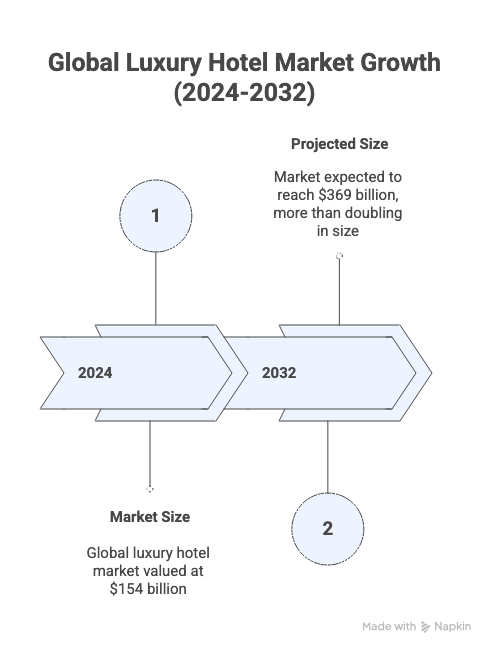
Fortune Business Insights
That part they got right.
But here's what they didn't say:
When luxury becomes the ONLY profitable segment, advisors without proper business infrastructure won't just struggle, they'll be priced out entirely.
The competition for the top 10% (and increasingly, the top 1%) is not only heating up but is also about to become vicious.
It's about to become vicious.
And if you're still operating like it's 2019, no clear positioning, no systems, treating every client inquiry like a custom project from scratch, you're not competing for premium clients.
You're competing for scraps they leave behind.
The math is simple but brutal:
Mass-market margins are collapsing. If you're booking $3,000 trips, your commission barely covers overhead.
Supplier relationships now favor top producers.
The advisors delivering HNWI clients get preferential allocation, better rates, exclusive access.
Everyone else gets waitlisted.
Technology is commoditizing low-end planning.
ChatGPT can plan a decent European itinerary for free.
But it can't replace a trusted advisor to a family worth $50M.
The middle is disappearing.
You're either positioned for premium, or you're competing with AI and OTAs for clients who see you as interchangeable.
This isn't a 2026 prediction. It's already happening.
But most advisors are still hoping "passion for travel" will be enough.
It won't.
— Alex Mustaros
Applied Reality
When Skift says luxury will dominate 2026, here's the translation:
The middle is gone.
A $3,000 trip at 10% commission nets you $300. After overhead and planning hours, you're working for less than minimum wage. Meanwhile, a $25,000 safari at the same rate? $2,500. Same effort. Eight times the revenue.
Suppliers are picking sides.
In 2023, I showed a luxury villa company our average booking value: $18,500 versus their network average of $9,200. Everything changed. Preferential allocation. Better rates. First access to inventory. Not because we booked more often—because we delivered more valuable clients.
AI is your filter, not your threat.
ChatGPT can plan a decent Portugal itinerary. What it can't do? Understand that "romantic anniversary trip" actually means "we need to remember why we're still married." If you're leading with logistics instead of transformation, you're competing exactly where AI wins.
The advisors thriving right now aren't more talented than the ones burning out. They just have business infrastructure the industry never taught them to build.
Three weeks ago, I broke down exactly what that infrastructure looks like; the five pieces that separate advisors who scale from those who plateau.
"The Secret to Scaling a Luxury Travel Business (It's Not More Clients)"
18 minutes. No fluff. Just pattern recognition from 15 years of watching who wins and who doesn't.
Marketing Corner
Your 2026 Positioning Checklist: 5 Signs You're Actually Positioned for Luxury

Most advisors think they have positioning because they say "I do luxury travel."
But positioning isn't what you say about yourself. It's what others can say about you without hesitation.
Here's what real positioning looks like:
1. Your clients can describe what makes you different in one sentence
Not: "She plans amazing trips."
But: "She's THE advisor for multi-generational Italy trips, culture without the chaos."
If someone asks what you do and people hedge with "well, she does a lot of different things...", you don't have positioning.
2. You own a specific category
Not: "Luxury travel worldwide"
But: "African safaris for couples celebrating major life transitions"
The brain can't remember "everything." It remembers specialists. Real positioning is [Destination] + [Client Type] + [Outcome].
3. Your positioning filters OUT wrong-fit clients naturally
When someone asks if you do budget backpacking and you say "that's not my specialty," your positioning is working.
Strong positioning should repel as many people as it attracts. If everyone could theoretically be your client, you have no position.
4. You can articulate the transformation, not just the itinerary
Not: "I plan trips to Italy"
But: "I help burned-out executives remember what it feels like to be fully present"
Fill in this blank: "My clients don't hire me to plan trips. They hire me to ___________."
If you can't finish that sentence, you're selling logistics. Not transformation.
5. People refer you with certainty, not qualifiers
Not: "She's great, but I don't know if she does that..."
But: "You HAVE to talk to her. She's the only person I'd trust for this."
Certainty in referrals is the ultimate positioning test.
Where Are You?
You don't need all five to be successful. But the more of these you have, the less you compete on price, the easier sales become, and the higher you can charge.
This is the foundation everything else builds on.
What Happens Next
Remember the advisor from the opening? The one shutting down her business despite being talented?
She had skill. She didn't have infrastructure.
And in a market where luxury is the only profitable segment, that gap becomes fatal.
The good news: most advisors still don't understand this.
Which means if you build the right infrastructure now, positioning, systems, authority, you're not fighting for scraps. You're capturing the clients everyone else is chasing with the wrong playbook.
In 20 days, I'm opening The Expert's Guild Community to a small group of founding members.
Not a course. Not a mastermind. A working community where we build this infrastructure together.
The business systems the industry never taught you, but that separate advisors who scale from those who plateau.
If you watched that video and resonated with it, you're exactly who this is for.
Want to be first to know when The Guild opens?
Reply to this email with "GUILD" and I'll add you to the list.
I'll reach out in mid-January when we open doors to the first 12 founding members.
But even if you don't join, use that positioning checklist above. Because 2026 isn't the year to hope your talent is enough.
It's the year to build the business that finally matches it.
Welcome to 2026,
Alex
Easy setup, easy money

Making money from your content shouldn’t be complicated. With Google AdSense, it isn’t.
Automatic ad placement and optimization ensure the highest-paying, most relevant ads appear on your site. And it literally takes just seconds to set up.
That’s why WikiHow, the world’s most popular how-to site, keeps it simple with Google AdSense: “All you do is drop a little code on your website and Google AdSense immediately starts working.”
The TL;DR? You focus on creating. Google AdSense handles the rest.
Start earning the easy way with AdSense.
Did you enjoy this week's Newsletter? |
📩 Share this email with your colleagues and invite them to join our expanding community of luxury travel professionals.
📫 If you received The Expert’s Guild Weekly from a friend and would like to subscribe, please do so here:
